
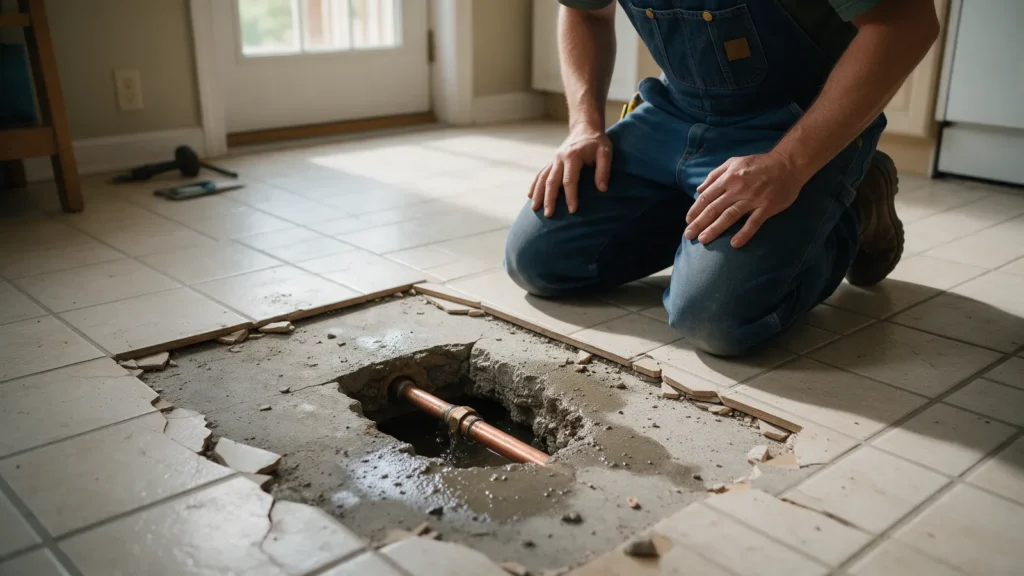
Slab leak repair cost depends on two things more than any other: how precisely the leak can be found, and how the plumber reaches the pipe. Finding it is a separate step with its own charge. Fixing it can mean opening the concrete at one spot, abandoning the line and running a new one through the walls or attic, or replacing the supply piping for the whole house.
For a home on a concrete slab in Salisbury or the surrounding towns, the smart order is to confirm the leak, pinpoint it, then choose the repair that fits the age and condition of the rest of the plumbing. A single patch on a sound system is reasonable. A third patch on tired pipe usually is not. This guide covers the price ranges, the warning signs and the choice between spot repair, reroute and repipe.
Slab Leak Repair Cost: National Figures
Local plumbing prices for Wicomico County are not published, so national data is the fairest benchmark. Angi’s 2026 data puts the national average slab leak repair cost at $2,280, including leak detection, with most homeowners paying between $630 and $4,400. HomeAdvisor reports the same average and a wider $300 to $6,750 spread, and This Old House lists a similar $2,300 average.
The total depends on which repair you need and what has to be restored afterward. Here are the national ranges for each piece.
| Item | Typical national range (2026) | Source |
|---|---|---|
| Slab leak repair, total (average $2,280) | $630 to $4,400 | Angi |
| Slab leak detection (average $280) | $150 to $400 | Angi |
| Pinhole leak repair | $150 to $800 | Angi |
| Pipe leak repair | $250 to $850 | Angi |
| Single burst pipe | $200 to $3,000 | Angi |
| Slab leak reroute | $600 to $4,000 | Angi |
| Cured-in-place lining | $80 to $250 per linear foot | Angi |
| Drain line leak repair | $800 to $5,000 | Angi |
| Concrete slab repair after access | $300 to $6,750 | Angi |
| Water damage restoration | $450 to $15,000 | Angi |
| Whole-house repipe (average $7,500) | $1,500 to $15,000 | Angi |
Angi notes that materials for most slab leak repairs cost under $100. The bill is mostly labor: locating the leak, cutting concrete, replacing pipe and patching the slab, at $500 to $4,000 in labor alone.
How to Tell If You Have a Slab Leak
Slab leaks hide under flooring, so the signs are often indirect. HomeAdvisor and This Old House list the same core symptoms:
- A water bill that climbs without any change in how you use water.
- The sound of running water when every fixture is off.
- A warm spot on the floor, which often points to a hot water line.
- Damp carpet, lifting tile or warped wood with no plumbing fixture nearby.
- A drop in water pressure that affects the whole house.
- Musty odors or mold near the base of walls.
You can run a basic check yourself. Turn off every faucet and water-using appliance, then watch the meter or its leak indicator for a while. If it moves, water is going somewhere. On a private well, a pump that cycles on when nobody is using water is the same warning.
Write down the meter reading and the time, then check again later with nothing running. That record is useful to the plumber and to an insurer, and it helps show whether the leak is steady or getting worse.
A meter test tells you a leak exists, not where it is. That is the job of professional leak detection in Salisbury, which uses pressure testing, acoustic listening and thermal imaging to narrow the search before any concrete is cut.
What Drives Slab Leak Repair Cost
How hard the leak is to find
Angi puts detection at $150 to $400 in most cases, with emergencies at the higher end. Accurate detection saves money later, because every foot of slab you do not open is a foot you do not have to patch.
Supply line or drain line
Pressurized supply lines leak constantly and show up on the meter. Drain line leaks only leak when water runs down them, so they are slower to spot and often cost more to fix. Angi puts drain line leak repair at $800 to $5,000.
Access method
Going straight down through the slab is the most direct route but means breaking and patching concrete. Tunneling from outside avoids interior floors but takes more labor. Rerouting skips the slab entirely.
What sits above the leak
Tile, hardwood and cabinets raise the restoration bill. Angi notes the cost to rebuild finishes is separate from the plumbing, and permits typically add $150 to $200.
Water damage
A leak that ran for months can soak subfloor, drywall and insulation. Angi puts water restoration at $450 to $15,000, which is why early detection matters more than any other cost factor.
Spot Repair, Reroute or Repipe?
The choice comes down to the condition of the pipe that did not leak yet.
Spot repair fixes the leak where it is. It makes sense for a first leak caused by a clear, local problem, such as a damaged fitting, in plumbing that is otherwise sound.
Reroute abandons the leaking line under the slab and runs a new one overhead or through walls. Angi puts reroutes at $600 to $4,000. It avoids breaking the floor and replaces the whole run, not just one spot.
Repipe replaces the supply piping for the house. Angi’s 2026 range is $1,500 to $15,000, averaging around $7,500, with PEX far less costly than copper. A repipe is worth pricing when:
- This is the second or third slab leak in a few years.
- Pinhole leaks are showing up in exposed pipe as well.
- The home still has original galvanized supply lines.
- You are already remodeling and walls or ceilings will be open.
If any of those apply, compare a single repair against repiping in Salisbury before you commit. Paying for one repair and then a repipe a year later costs more than going straight to the lasting fix.
Why Water Chemistry Matters on the Lower Shore
Corrosion is one of the main causes of pinhole leaks in copper, and local water is part of the story. A study of pinhole leaks by the Cobb County-Marietta Water Authority notes that groundwater in Southern Maryland and the Eastern Shore is generally more acidic than surface water, with pH values around 6.5. It adds that low-pH water is often found in private well systems.
The Wicomico County Water and Sewer Master Plan says homes on wells near Salisbury and Fruitland often use softeners and treatment systems to deal with low pH and high iron. If you are on a well and have had a pinhole leak, have the water tested before you repair. Neutralizing acidic water protects whatever pipe you install next.
Public systems treat for this. The City of Salisbury’s 2025 water quality report lists corrosion control among its treatment steps. In Pittsville, the town changed treatment in 2019 to address excessive iron in the finished water drawn from its two Pocomoke aquifer wells. Homeowners there can get leak testing from a plumber serving Pittsville, MD.
Slab Leaks on Private Wells
A leak under the slab behaves a little differently when the house runs on a well. There is no water bill to spike, so the first clue is often the pump. If you hear it kick on at night, or the pressure tank cycles when no one is using water, something is drawing from the system.
The county Master Plan lists the village of Parsonsburg among the areas served by individual wells and septic systems, and notes that many lots near Walston Switch Road and Parsonsburg Road are under an acre. A hidden leak on a well property costs you in pump wear and electricity rather than water charges. Meanwhile the water keeps soaking the soil under the slab, which can show up later as damp flooring, musty odors or mold along the base of walls.
Treat a cycling pump the same way you would treat a moving meter. Shut off fixtures, isolate the water heater and outdoor lines if you can, and see whether the pump still runs. A plumber in Parsonsburg, MD can check for leaks and talk through water treatment at the same visit, since acidic well water and pinhole leaks often go together.
What Happens During a Slab Leak Repair
Most jobs follow the same order. Detection comes first, with the leak marked on the floor. Next, the plumber confirms which line is leaking and lays out the repair options with prices. Once you choose, a permit is pulled where one is required.
For a spot repair, the crew protects the room, cuts a section of flooring and concrete, replaces the damaged pipe, pressure tests the line and patches the slab. For a reroute, new pipe runs through walls, ceilings or the attic, connects at each fixture, and the old line is capped and left in place. Either way, the system is pressure tested before walls or floors are closed, and the finish work follows.
Older Plumbing in Salisbury Homes
Age adds risk. Census data show that about 46% of Salisbury’s homes were built before 1980 and about 25% before 1960. Pipes that have been in service for decades are more likely to have thinned walls, failing joints or materials that are no longer installed.
The City of Salisbury’s 2025 water quality report notes that homes built before 1986 have an increased risk of lead in the plumbing. Its service line inventory lists 15 galvanized lines and 7,528 lines of unknown material. A slab leak is a good moment to learn what your home’s pipes are made of, because that shapes whether a repair or a repipe makes more sense.
Does Insurance Cover a Slab Leak?
Sometimes, in part. Angi and HomeAdvisor both explain that most homeowners policies cover sudden and accidental damage from a covered peril. Gradual problems, such as corrosion-related pinhole leaks or root intrusion, are often excluded.
Even when the water damage is covered, the plumbing repair itself may not be. Call your insurer before major work, photograph the damage, and keep the detection report and invoices. The detection findings often matter as much as the repair bill in a claim.
How to Get an Accurate Slab Leak Repair Quote
- Confirm the leak with a meter test. Note how fast the meter moves with everything off.
- Get professional detection first. Ask for the leak location marked on the floor and a written report.
- Ask which line is leaking. Hot, cold, or drain changes the repair path.
- Request options side by side. Spot repair, reroute and repipe, each with a price.
- Clarify restoration. Does the quote include concrete patching, flooring or drywall, or only the plumbing?
- Ask about the permit. Who pulls it and whether the fee is included.
You can check whether your town is covered on our service areas page, or speak with a plumber in Salisbury, MD about what your meter is showing.
Outside Salisbury, we also handle leak detection and slab leak repair for homeowners looking for a plumber in Berlin, MD or a plumber in Powellville, MD.
Related guide: Repipe Cost in Salisbury, MD: Whole House Repiping Prices and What Drives Them.
FAQs
How much does it cost to fix a slab leak?
Angi’s 2026 national average is $2,280 including detection, with most repairs between $630 and $4,400. Reroutes, drain line leaks and heavy restoration push costs higher. Local prices are not published, so the firm number comes from a written quote after detection.
How much does slab leak detection cost?
Angi puts slab leak detection at about $280 on average, with most homeowners paying $150 to $400. Emergency calls and hard-to-find leaks land at the higher end.
Is it better to reroute or repair a slab leak?
A spot repair suits a first leak in otherwise sound pipe. Rerouting replaces the whole run and avoids breaking the floor, so it often makes more sense in older homes or after a second leak.
Can a slab leak damage my foundation?
A long-running leak can saturate the soil under the slab and damage flooring and finishes. HomeAdvisor lists concrete slab repair at $300 to $6,750, so catching the leak early limits the damage.
Does well water cause slab leaks?
Acidic water can corrode copper and lead to pinhole leaks. Groundwater on the Eastern Shore is often acidic, so well owners with repeat leaks should test and treat their water.
A climbing water bill or a warm spot on the floor is worth checking before it turns into a flooring job. Call (410) 968-5894 to arrange testing and a written estimate, or read more about leak detection in Salisbury.
Let’s Get It Sorted
Ready to Talk Through Your Project?
Share the details with our team and take the next step.
Call Now
→
Call Today: