
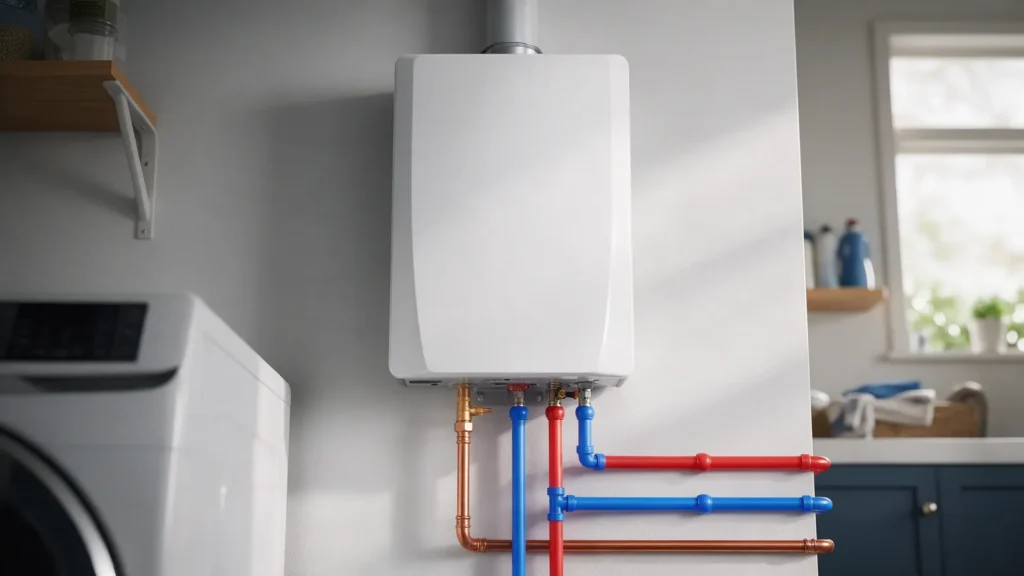
Tankless water heater cost is higher up front than a standard tank, and the gap comes less from the unit and more from what the house needs to run it. A whole-house tankless heater often needs a larger gas line, new venting or a bigger electrical circuit. When those upgrades are already in place, the price gap narrows. When they are not, they can cost as much as the heater.
The other half of the decision is tankless vs tank water heater over the long run. A tankless unit heats water only when a tap opens, lasts longer and frees up floor space. A tank costs less to buy and install and handles several showers at once without careful sizing. This guide lays out the price ranges, what pushes a quote up in Salisbury and nearby towns, and how to tell which option fits your home.
Tankless Water Heater Cost: What the National Data Shows
No one publishes local installation prices for the Lower Eastern Shore, so national figures are the fairest yardstick. Angi’s 2026 cost data puts the average tankless installation at $2,641, with most projects falling between $1,406 and $3,902. HomeAdvisor lists the same $1,400 to $3,900 installed range, and HomeGuide’s 2026 guide runs higher, at $1,400 to $5,600.
Those spreads are wide because “tankless” covers everything from a small electric unit under one sink to a large condensing gas heater serving three bathrooms. The table breaks the national numbers into the pieces you will see on a quote.
| Item | Typical national range (2026) | Source |
|---|---|---|
| Tankless heater, installed (average $2,641) | $1,406 to $3,902 | Angi |
| Tankless heater, installed | $1,400 to $5,600 | HomeGuide |
| Standard tank, installed (for comparison) | $600 to $2,500 | Angi |
| Whole-house tankless unit only | $450 to $1,500 | Angi |
| Single-point unit only | $100 to $300 | Angi |
| Labor, tankless install | $600 to $1,900 | Angi, HomeAdvisor |
| Labor, converting tank to tankless | $150 to $2,500 | Angi, HomeAdvisor |
| Larger gas supply line | $350 to $2,000 | HomeGuide |
| New dedicated electrical circuit | $250 to $900 | HomeGuide |
| Permit | $50 to $100 | Angi |
| Tankless repair, typical | $100 to $1,300 | Angi |
Read the table as a menu, not a bill. A gas home that already has a properly sized line and a good spot on an outside wall may need none of the extras. A home switching from an old electric tank to an electric tankless may need a panel upgrade first.
Tankless vs Tank Water Heater: How They Compare
A storage tank keeps 40 or 50 gallons hot around the clock. A tankless heater sends cold water through a heat exchanger and fires a gas burner or electric element only while hot water flows. That one difference drives most of the trade-offs.
- Upfront price. Tanks win. Angi puts tank installs at $600 to $2,500 against $1,400 to $3,900 for tankless.
- Lifespan. Tankless wins. The U.S. Department of Energy says most tankless units last more than 20 years, while storage heaters last 10 to 15.
- Running cost. Tankless usually wins, by an amount that depends on how much hot water you use. Details are in the payback section below.
- Hot water supply. A tankless unit never runs out, but it can only heat so much water at once. A tank delivers a big burst, then needs time to recover.
- Space. Tankless units mount on a wall and free up a closet or corner of the garage.
- Repairs. Tank repairs are cheaper, at $100 to $500 per Angi, compared with $100 to $1,300 for tankless.
- Leak risk. No stored water means no tank to rupture and flood a utility room.
Neither option is right for every house. A couple in a small home with modest hot water use often does well with a tank. A larger household that runs out of hot water, or anyone planning to stay put for many years, may come out ahead with a tankless water heater. See tankless water heaters in Salisbury, MD.
Why Converting From a Tank Raises Tankless Water Heater Cost
Swapping an old tankless heater for a new one is a contained job. Converting from a tank is not, and that is where quotes climb. Angi notes that first-time tankless installs cost more than replacements because they need extra piping and electrical work.
Gas line sizing
A whole-house gas tankless heater burns far more fuel at full fire than a tank burner does. Many older homes have a gas line sized for the tank, a furnace and a range, not for a large tankless unit. Upsizing that line is one of the most common add-ons.
Venting
Tankless gas heaters cannot share an old metal flue built for a tank. Condensing models vent through plastic pipe, usually out a side wall, and need a drain for the acidic condensate. The vent route and the wall it exits through affect labor.
Electrical service
Electric whole-house tankless units draw heavy current. Angi notes that some need 120 to 160 amps, which can mean upgrading to 200 amp service. Point-of-use units need far less, which is why they are popular for a single bathroom far from the main heater.
Location
Moving the heater to an outside wall shortens the vent but may add water piping. Our page on water heater installation in Salisbury covers placement for both tank and tankless units.
Gas, Propane or Electric Tankless?
Fuel choice changes both the unit price and the installation. Angi’s fuel table puts electric tankless units at $450 to $1,500, and natural gas and propane units at $1,000 to $1,500 each, before labor. Electric models cost less to buy, but a whole-house electric unit can trigger the panel upgrade described above.
Gas-fired units deliver higher flow rates than electric ones, according to the Department of Energy, which makes them the usual pick for larger households. The DOE also advises choosing a model with an intermittent ignition device instead of a standing pilot light, since a pilot burning all day eats into the savings.
Homes without natural gas service can run a propane tankless unit instead. These work the same way as natural gas models, but the propane tank, regulator and line size all need checking. If your current tank heater is electric and you have no gas on site, a point-of-use unit or a heat pump tank may cost less than a full conversion.
Cold Groundwater, Winter Flow Rates and Sizing
Sizing matters more on the Eastern Shore than many buyers expect. A tankless heater is rated by flow rate, and the Department of Energy says most units deliver 2 to 5 gallons per minute. That output drops as the incoming water gets colder, because the heater has to raise the temperature further.
Salisbury’s January average low sits around 28 to 29°F under NOAA’s 1991 to 2020 climate normals. Groundwater and buried water lines cool through the winter, so a heater that keeps up with two showers in September may struggle in February. A correctly sized unit is chosen for winter inlet temperatures, not summer ones.
The DOE gives a useful example of the limit: a shower and a dishwasher running together can stretch even a large gas model. If your household often runs several fixtures at once, ask the installer to show the sizing math. Some homes solve it with two units, or with a small point-of-use heater added for a far bathroom.
Well Water, Iron and Upkeep Costs
Water quality shapes the long-term cost of a tankless heater. The Wicomico County Water and Sewer Master Plan notes that homes on private wells near Salisbury and Fruitland often use softeners and treatment systems for low pH and high iron. Iron and minerals build up inside a heat exchanger and cut its output.
Forbes Home puts tankless maintenance at $45 to $200 per visit, and Angi lists a water heater flush at $110 to $200. Many manufacturers call for descaling at regular intervals, more often on untreated well water. Budget for that upkeep when you compare a tankless unit against a tank.
Town water is not identical everywhere, either. In Princess Anne, the Somerset County Sanitary District draws from Manokin and Patapsco aquifer wells and tests daily for pH, chlorine, total iron and phosphate. If you are weighing tankless there, a plumber serving Princess Anne, MD can review your water before you choose a model.
Is a Tankless Water Heater Worth the Cost?
The honest answer depends on how much hot water your home uses. According to the U.S. Department of Energy, tankless heaters can be 24% to 34% more energy efficient than storage tanks in homes that use 41 gallons or less of hot water a day. For homes using around 86 gallons a day, the gain falls to 8% to 14%.
In dollar terms, ENERGY STAR estimates that a certified gas tankless heater saves a family of four about $95 a year on gas compared with a standard gas tank. That adds up to roughly $1,800 over the heater’s life. Set that against a price gap of $1,000 or more over a tank, plus descaling costs, and the payback runs many years.
Tankless tends to pay off when several of these apply:
- You plan to stay in the home for ten years or longer.
- The gas line, venting route or electrical service already suits a tankless unit.
- The household regularly runs out of hot water with the current tank.
- Floor space is tight, or a tank leak would damage finished rooms.
- You are prepared to keep up with descaling, especially on well water.
If only one or two apply, a new high-efficiency tank or a heat pump tank may be the better value. That reflects how much of the total sits in the installation rather than the heater.
Getting an Accurate Tankless Quote
Tankless quotes vary more than tank quotes because the scope varies. Give the installer enough detail to price your house:
- List your fuel. Natural gas, propane or electric, and where the gas meter or propane tank sits.
- Count peak fixtures. How many showers, sinks and appliances run at the same time on a busy morning.
- Describe the current heater. Its size, age and location, and how the flue exits the house.
- Share your electrical panel size. This matters most for electric tankless.
- Mention water treatment. City water, a well, and any softener or iron filter in place.
- Ask for line items. Unit, labor, gas line, venting, electrical, permit and removal of the old tank.
In Berlin, where the town draws water from three Pocomoke aquifer wells and about 41% of homes were built in 2000 or later, newer houses are more likely to have the panel capacity and venting paths a tankless unit needs. A plumber in Berlin, MD can check what your house already has before quoting. You can also see every town on our service areas page.
Outside Salisbury, we also handle tankless water heater installs for homeowners looking for a plumber in Fruitland, MD or a plumber in Eden, MD.
Related guide: Water Heater Replacement Cost in Salisbury, MD: 2026 Price Guide.
FAQs
How much does a tankless water heater cost to install?
Angi’s 2026 national average is $2,641, with most installs between $1,406 and $3,902. Conversions from a tank cost more when the gas line, venting or electrical service needs upgrading. Local prices are not published, so a written quote for your home is the only firm figure.
Is tankless better than a tank water heater?
Tankless lasts longer and uses less energy, especially in homes with modest hot water use. A tank costs less up front and copes better when several fixtures run at once. The better choice depends on your household, your fuel and how long you plan to stay.
How long does a tankless water heater last?
The Department of Energy says most tankless heaters last more than 20 years, compared with 10 to 15 years for storage tanks. Regular descaling helps them reach that age, particularly on well water with iron or minerals.
Can a tankless heater keep up in a Maryland winter?
Yes, if it is sized for winter inlet water. Colder groundwater lowers how much hot water a unit can deliver at once. Ask the installer to size the heater for your coldest months, not the average.
Do I need a permit to install a tankless water heater?
In most cases, yes. Inside Salisbury city limits, only a master plumber can apply for the plumbing permit. Outside the city, Wicomico County Permits and Inspections handles plumbing permits.
Choosing between tankless and tank comes down to your hot water use, your fuel and what the house already has in place. A plumber in Salisbury, MD can size the unit for winter and price every line before work starts. Call (410) 968-5894 to talk it through, or read more about tankless water heater installation in Salisbury.
Let’s Get It Sorted
Ready to Talk Through Your Project?
Share the details with our team and take the next step.
Call Now
→
Call Today: